


Which manufacturer makes the best heat exchangers? Working principle of heat exchangers
Release Time:
2020-09-23 13:02
Source:
Heat exchangers are suitable for heating, bathing, and air conditioning systems in residential buildings, factories, mines, hospitals, hotels, and other places. Integrated heat exchangers are not only used for water - water exchange, but also for water and steam-water exchange. The heat exchanger unit consists of a heat exchanger, circulation pump, water pump, electrical control cabinet, filter, base, pipes, valves, instruments, etc. It can be configured with automatic constant pressure water supply device, water treatment equipment, water tank, water pump frequency conversion control, temperature control valve, remote communication control, etc., forming a complete heat exchanger unit. The heat exchanger unit has a standardized and modular design, complete configuration, easy installation, energy saving, and is widely used in community centralized heating, domestic water, and industrial process water systems.
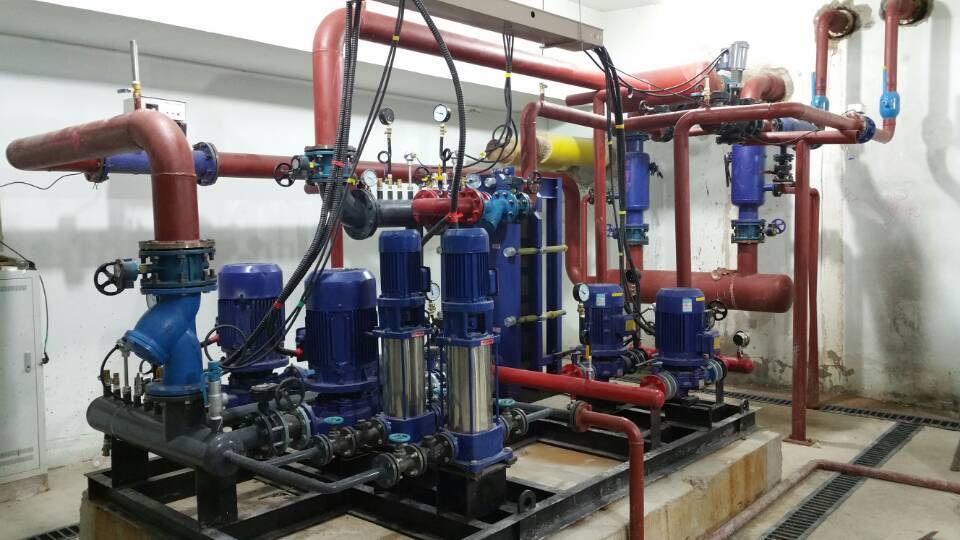
The heat exchanger unit automatically and continuously converts heat into domestic water and heating water. That is to say, after the hot water enters the heat exchanger unit from the primary side inlet, it flows out from the outlet of the heat exchanger unit through heat exchange, and the scale is removed through the filter. The secondary circulating water enters the heat exchanger unit for heat exchange, producing water of different temperatures to meet the needs of users, such as heating, air conditioning, floor heating, or domestic water.
After water purification and filtration, it is circulated into the heat exchanger unit and heated by steam or hot water for heating. Steam or hot water then enters the heat exchanger unit and returns to the heat source as condensate or hot water, circulating through the primary and secondary heating system loops. The makeup water pump sends softened water into the system to maintain constant system pressure.
Related News
Moments from the "United in Heart, Creating Glory" 2025 Shandong Youkun Annual Conference
Moments from the "United in Heart, Creating Glory" 2025 Shandong Youkun Annual Conference
Vice Mayor Shu Huawen visits and investigates Shandong Youkun
During this period, the person in charge of our company gave an on-site report on the company's operation and the strict implementation of various requirements and measures for the prevention and control of the novel coronavirus pneumonia epidemic, which was unanimously praised by the leaders!
On September 22nd, a completion and commissioning ceremony was held at Shandong Youkun Energy Equipment Co., Ltd. in Kenli Economic Development Zone. With the general manager's starting order, the sound of machinery could be heard continuously.
Heat Exchanger Unit Manufacturer: Characteristics of Boiler Auxiliary Equipment
Boiler auxiliary equipment actually refers to a complete set of equipment for a boiler. This is a relatively general concept, including induced draft fans, fans, pulverizers, coal feeders, slag removal machinery, etc. Next, we will introduce the characteristics of boiler auxiliary equipment one by one to help you better understand boiler auxiliary equipment.
Heat exchanger manufacturer: Burners in boiler auxiliary equipment
Burners are among the auxiliary equipment of boilers. A burner includes an ignition system, an air supply system, a monitoring system, a fuel system, an electrical control system, etc. The air supply system sends a certain amount of air into the combustion chamber. Its main components include a fan, impeller, casing, motor, damper controller, diffuser, etc. This article will introduce the burner in boiler auxiliary equipment in detail, helping you better understand its performance and structure.
How is the pressure vessel industry developing?
Encouraged by national cultural industry economic policies, the metal pressure vessel industry benefits from relevant information industry policies and national industrial policies. A favorable analysis of the industrial policy environment is conducive to the sustained development of this industry in the future.