


Heat Exchanger Unit Manufacturer: Why use a plate heat exchanger?
Release Time:
2020-10-09 15:22
Source:
When it comes to plate heat exchangers, many people may not know what they are, but let me tell you that they are used in central air conditioners. The main reason for using plate heat exchangers is :
1 the refrigerant in the internal - water heat exchanger in the central air conditioner unit. - Heat exchangers generally come in three types: tube-in-tube, shell-and-tube, and plate heat exchangers. Tube-in-tube and shell-and-tube heat exchangers are typically used in large units and have the advantages of low pressure loss, low water quality requirements, and resistance to clogging. Plate heat exchangers are generally used in smaller units and have the advantages of small size and high efficiency. If it is a water system unit, there must be a heat exchanger; if it is not a plate type, it must be another type.
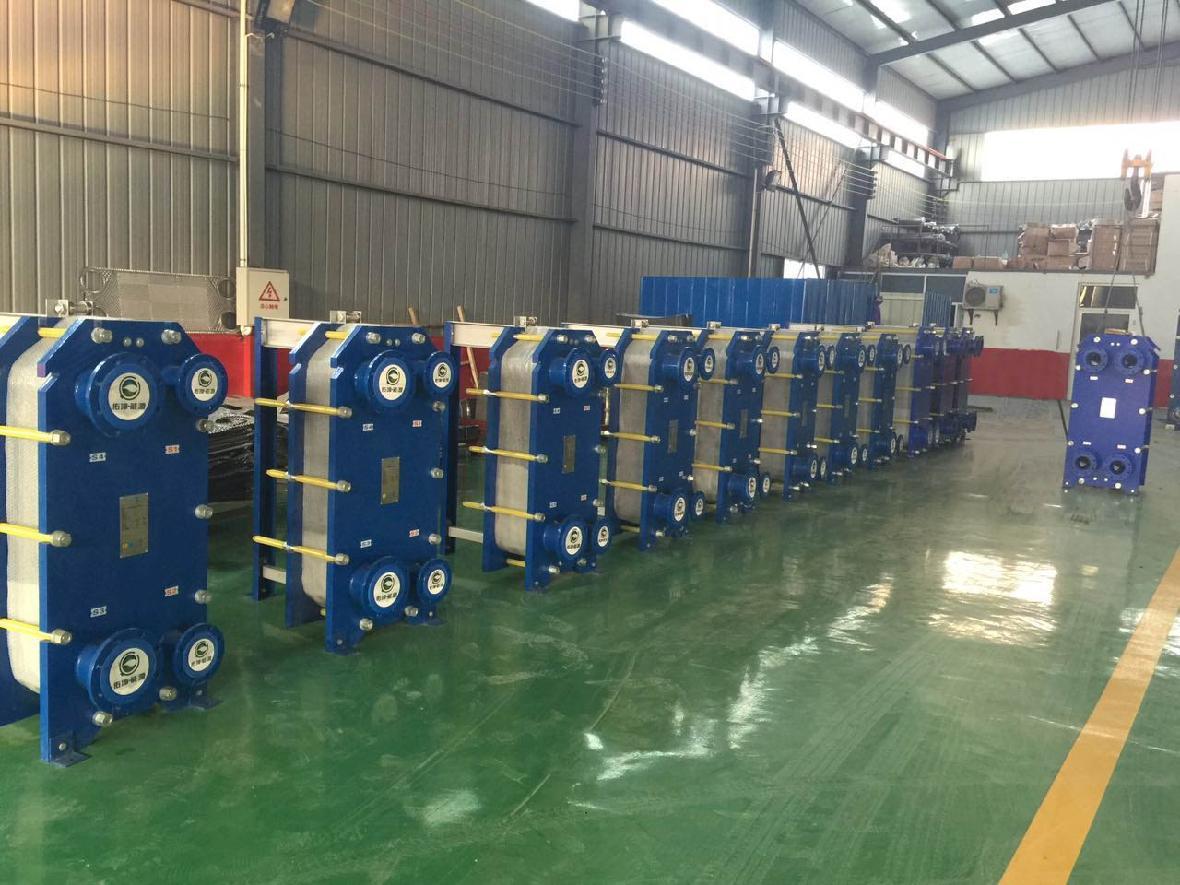
2 Central air conditioning water systems that use small heating boiler technology for heating will have a heat exchanger, usually a plate heat exchanger, connected in series with the air conditioning unit. This is used for heat exchange between the air conditioning system water and the boiler heating water. During winter use, the boiler temperature is set, and when the water in the furnace reaches a certain set temperature, the circulation pump begins heating, circulating water to the heat exchanger, and heating the return water in the main air conditioning system pipeline. If the heat exchanger is removed to save costs, the heating boiler must be connected in parallel to the main pipe. When used, the main system circulation pump and the boiler heating circulation pump will compete for water, causing insufficient boiler heating water flow and rendering the boiler ineffective. If a gate valve is added to the parallel section of the boiler, the valve is closed during heating, and the boiler circulation pump is removed; this is equivalent to connecting the boiler in series to the air conditioning pipeline system. The small circulation pump in the furnace will suppress the flow of the main system circulation pump, resulting in the boiler only providing auxiliary heating and not providing domestic hot water. Due to the principle of boiler structure, as soon as the air conditioner is turned on, domestic hot water will not heat up. Therefore, a plate heat exchanger should also be used in the case of auxiliary heating from the boiler.
This is why plate heat exchangers are necessary. The above shows the functions of heat exchangers. If a heat exchanger malfunctions, many problems can occur. Therefore, proper cleaning and maintenance of the plate heat exchanger is essential to prevent damage.
Related News
Moments from the "United in Heart, Creating Glory" 2025 Shandong Youkun Annual Conference
Moments from the "United in Heart, Creating Glory" 2025 Shandong Youkun Annual Conference
Vice Mayor Shu Huawen visits and investigates Shandong Youkun
During this period, the person in charge of our company gave an on-site report on the company's operation and the strict implementation of various requirements and measures for the prevention and control of the novel coronavirus pneumonia epidemic, which was unanimously praised by the leaders!
On September 22nd, a completion and commissioning ceremony was held at Shandong Youkun Energy Equipment Co., Ltd. in Kenli Economic Development Zone. With the general manager's starting order, the sound of machinery could be heard continuously.
Heat Exchanger Unit Manufacturer: Characteristics of Boiler Auxiliary Equipment
Boiler auxiliary equipment actually refers to a complete set of equipment for a boiler. This is a relatively general concept, including induced draft fans, fans, pulverizers, coal feeders, slag removal machinery, etc. Next, we will introduce the characteristics of boiler auxiliary equipment one by one to help you better understand boiler auxiliary equipment.
Heat exchanger manufacturer: Burners in boiler auxiliary equipment
Burners are among the auxiliary equipment of boilers. A burner includes an ignition system, an air supply system, a monitoring system, a fuel system, an electrical control system, etc. The air supply system sends a certain amount of air into the combustion chamber. Its main components include a fan, impeller, casing, motor, damper controller, diffuser, etc. This article will introduce the burner in boiler auxiliary equipment in detail, helping you better understand its performance and structure.
How is the pressure vessel industry developing?
Encouraged by national cultural industry economic policies, the metal pressure vessel industry benefits from relevant information industry policies and national industrial policies. A favorable analysis of the industrial policy environment is conducive to the sustained development of this industry in the future.