



Reverse osmosis device
Keywords:
Product Category:
Reverse osmosis equipment is a membrane separation technology developed in the 1980s. It mainly utilizes the principle of osmosis of semi-permeable membranes. By applying a certain pressure in a way that counteracts the natural direction of osmosis, water in a concentrated solution is allowed to permeate into a dilute solution. This method is called reverse osmosis. The device composed of reverse osmosis elements is a reverse osmosis device.
Main Uses
1. Production of pure water and ultrapure water required for electronic industry processes, such as the production of CRT glass shells, CRTs, LCDs, circuit boards, computer hard drives, integrated circuit chips, and monocrystalline silicon semiconductors;
2. Production of softened water and demineralized pure water required for thermal power, coal-fired power plant boilers, and medium and low-pressure boilers in factories and mines;
3. Production of pure water for large-volume infusions, injections, medicines, biochemical products, medical sterile water, and pure water for hemodialysis used in the pharmaceutical industry;
4. Production of drinking pure water, distilled water, mineral water, water for wine brewing, and water for mixing in the beverage (including alcohol) industry;
5. Production of domestic and drinking water from seawater and brackish water;
6. Production of deionized water for electroplating; pure water for battery (storage battery) production processes; pure water for surface coating and cleaning of automobiles, household appliances, and building materials; pure water for coated glass; hard water and salt removal water for textile dyeing processes;
7. Petrochemical industry, such as chemical reaction cooling water; process water for chemical reagents, fertilizers, fine chemicals, and cosmetics manufacturing;
8. High-quality water supply network systems and swimming pool water purification for hotels, buildings, communities, and airport properties;
9. Treatment and reuse of wastewater from circuit boards, electroplating, and the electronics industry;
10. Treatment of domestic wastewater, hospital wastewater, tanning wastewater, dyeing wastewater, papermaking wastewater, and leachate from landfills;
Features of Reverse Osmosis Devices:
(1) Solutes and water can be separated at room temperature without phase change. Suitable for the separation and concentration of heat-sensitive substances; Compared with separation methods involving phase change, energy consumption is lower.
(2) Wide range of impurity removal, capable of removing inorganic salts, organic impurities, bacteria, and viruses.
(3) High desalination rate, can achieve >99% (4) Simple separation device, easy to operate, control and maintain.
(5) Has certain requirements for the influent water quality, such as pollution density index (SDI15) ≤5, turbidity <1.0NTU, and ensuring that there is no residual chlorine or similar oxides.
Reverse osmosis devices mainly utilize chemical reactions to remove oxygen in the water. Before entering the boiler softener, the oxygen in the water is converted into stable metals or other chemical compounds through the reverse osmosis device, thus eliminating it. Electrochemical deoxygenation uses the principle of electrochemical protection, causing another easily oxidized metal to undergo electrochemical corrosion, consuming the oxygen in the water to remove it. This method is simple, easy to operate, and has low operating costs. It is widely used in low-pressure boilers or hot water boilers to supply oxygen.
Principle of Reverse Osmosis Device: A semi-permeable membrane separates the solution from the pure solvent. Due to the concentration difference, the pure solvent will diffuse to the solution side, which is called osmosis. If pressure is applied to the solution side, exceeding the osmotic pressure, the solvent on the solution side will flow towards the pure solvent side, thus achieving the separation of solute and solvent, which is called reverse osmosis.
Reverse osmosis equipment includes five parts: a 5μ security filter, a high-pressure pump, a reverse osmosis membrane assembly, a cleaning system, and control instruments.
A, 5μ Security Filter
To prevent damage to the membrane elements during operation, a 5μ security filter is installed before each reverse osmosis system. Its function is to intercept particles larger than 5μ from the pretreated water from entering the reverse osmosis membrane assembly. These particles, after being pressurized by the high-pressure pump, may puncture the reverse osmosis membrane assembly, causing significant salt leakage, and may also scratch the impeller of the high-pressure pump. The security filter in this system uses a melt-blown polypropylene filter element, which features deep filtration, large dirt holding capacity, long life, and easy replacement. It should be replaced when the pressure difference between the inlet and outlet of the filter exceeds the set value (usually 0.07-0.1MPa).
B, High-Pressure Pump
The high-pressure pump provides sufficient inlet water pressure for the reverse osmosis membrane assembly to maintain normal operation. Each reverse osmosis system is equipped with one set of South Special Pump stainless steel vertical multi-stage high-pressure pumps.
C, Reverse Osmosis Membrane Assembly
The reverse osmosis equipment system utilizes the characteristics of the reverse osmosis membrane to remove most of the soluble salts, colloids, organic matter, and microorganisms in the water. After pretreatment, the qualified raw water enters the membrane assembly placed in the pressure vessel. Water molecules and a small amount of low-molecular-weight organic matter pass through the membrane layer and are collected through the collecting pipeline, then pass to the product water pipe and then to the subsequent system.
D, Cleaning Device
The purpose of cleaning is to prepare a certain concentration of specific cleaning solution according to the pollution situation of the reverse osmosis membrane during operation, remove pollutants from the reverse osmosis membrane, and restore the original characteristics of the membrane.
No matter how thorough the pretreatment is, the reverse osmosis membrane will still be polluted by scaling after long-term use. Therefore, this system has a reverse osmosis cleaning device, which can be used for chemical cleaning when the membrane assembly is polluted.
E, Control System
The control system uses a SIMATIC S7-300 programmable logic controller (PLC) for data acquisition and system control. The control system can centrally monitor, manage, and automatically control the entire process system. All steps of the entire system are automatically performed by the PLC program, and the process flow and parameters are centrally monitored on the host instrument panel.
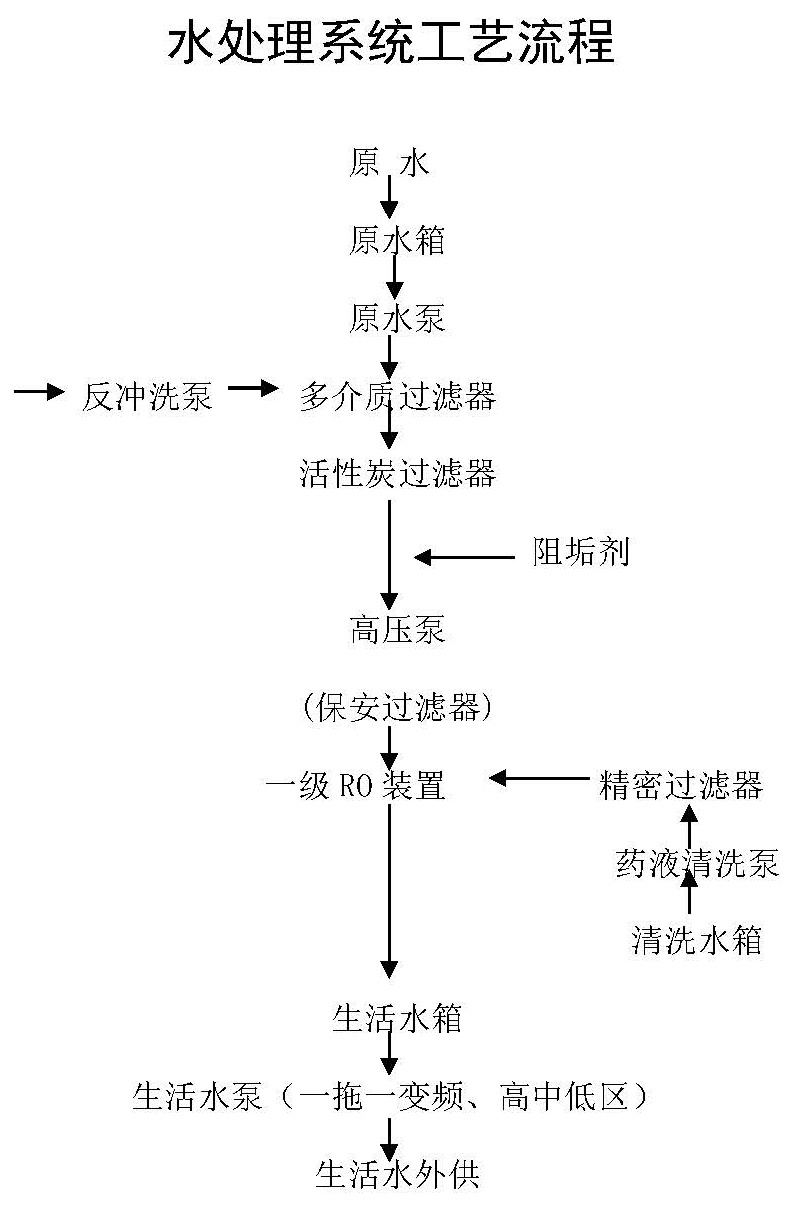
A membrane that is selectively permeable to substances is called a semipermeable membrane. A membrane that only allows the passage of solvent but not solute is generally considered an ideal semipermeable membrane. When equal volumes of dilute and concentrated solutions are placed on either side of a container separated by a semipermeable membrane, the solvent in the dilute solution will naturally pass through the semipermeable membrane and flow toward the concentrated solution side. The liquid level on the concentrated solution side will be higher than that of the dilute solution by a certain height, forming a pressure difference and reaching osmotic equilibrium. This pressure difference is the osmotic pressure. The magnitude of the osmotic pressure depends on the type and concentration of the concentrated solution, and the temperature; it is unrelated to the nature of the semipermeable membrane. If a pressure greater than the osmotic pressure is applied to the concentrated solution side, the solvent in the concentrated solution will flow toward the dilute solution, resulting in reverse osmosis.
Reverse osmosis is the most sophisticated membrane-based liquid separation technology. Operating pressure is applied to the feedwater (concentrated solution) side to overcome the natural osmotic pressure. When the operating pressure exceeding the natural osmotic pressure is applied to the concentrated solution side, the natural flow direction of water molecules will be reversed. Some water molecules in the feedwater (concentrated solution) will pass through the reverse osmosis membrane to become purified water on the dilute solution side. Reverse osmosis equipment can block all soluble salts and organic substances with a molecular weight greater than 100, but allows water molecules to pass through. The desalination rate of reverse osmosis composite membranes is generally greater than 98%. They are widely used in the preparation of industrial pure water and electronic ultrapure water, the production of drinking purified water, boiler feed water, etc. Using reverse osmosis equipment before ion exchange can significantly reduce the amount of water used and wastewater discharged.
Service life of reverse osmosis membrane: The reverse osmosis membrane is the most expensive component in the entire equipment, and its service life is related to the operating cost of the entire equipment. The normal service life of membrane elements is more than three years, but this is contingent on the reasonable selection and matching of the entire equipment, proper operation methods, timely material replacement, and regular cleaning and maintenance of the membrane elements as needed.
Service life of reverse osmosis membrane: The reverse osmosis membrane is the most expensive component in the entire equipment, and its service life is related to the operating cost of the entire equipment. The normal service life of membrane elements is more than three years, but this is contingent on the reasonable selection and matching of the entire equipment, proper operation methods, timely material replacement, and regular cleaning and maintenance of the membrane elements as needed.
Increased conductivity of the permeate: The condition of the equipment at each stage needs to be recorded in a timely manner. A slow increase in conductivity and a slight decrease in desalination rate are normal phenomena; appropriate maintenance should be performed according to the cause of the conductivity increase. If the conductivity increases suddenly, it may be necessary to consider whether there is membrane element damage, significant changes in raw water quality, or failure of some pretreatment material.
Little change in water quality after cleaning the reverse osmosis membrane:
a. Whether the membrane element is damaged
b. Whether some pretreatment material has failed
c. The type and degree of pollution of the membrane element were not clarified during membrane cleaning, and therefore the treatment was not targeted.
Excessive system pressure difference: According to the different membrane elements, the system pressure difference should be controlled within a reasonable range to avoid damage to the membrane elements. Low raw water utilization rate and excessive concentrate discharge: Whether the water inflow is sufficient, whether the pressure meets the operating conditions of the material, and whether the equipment design is reasonable.
1. Basic principle of reverse osmosis water treatment equipment
When pure water and saltwater are placed in two different solutions, half of the water passes through the membrane, and the concentration of water in the water will be permeated by the seawater, and the equilibrium of the resulting liquid is called osmotic pressure. If pressure (i.e., pressure greater than osmotic pressure) is applied to the saltwater, the water flow direction is reversed, which is reverse osmosis (reverse osmosis).
2. Reverse osmosis water treatment equipment
Reverse osmosis technology uses pressure difference as the driving force for membrane separation and filtration technology. Originating in the United States in the 1960s from aerospace technology research, it has gradually transitioned to civilian use and is widely used in scientific research, medicine, food, beverages, seawater desalination, and other fields. The pore size of the RO reverse osmosis membrane is nanometers (1 nanometer equals 10-9 meters). Under a certain pressure, water molecules can pass through the reverse osmosis membrane, while inorganic salts in the water source, heavy metal ions, organic matter, colloids, bacteria, viruses, and other impurities cannot pass through the reverse osmosis membrane, enabling the separation of water permeate from water concentrate.
The conductivity of the pure water after membrane filtration is 5 μS/cm, which meets the national standard for Grade 3 water. After the atomic-level ion exchange column, the resistivity of the water can reach 18.2 MΩ·cm, exceeding the national laboratory standard (GB682-92).
3. Applications and pretreatment considerations of reverse osmosis water treatment equipment
Reverse osmosis equipment is increasingly widely used. This equipment uses advanced reverse osmosis membrane separation technology and is an important piece of equipment for removing most of the salts, bacteria, viruses, and other impurities from raw water. It is also a key treatment link for ensuring the water quality of the equipment's output.
There are three main types of malfunctions in reverse osmosis equipment: reduced water permeability, increased salt passage rate (decreased desalination rate), and increased pressure drop. However, there are many reasons for these malfunctions. It is important to find the root cause of these malfunctions to quickly implement maintenance and other countermeasures.
The most common problems in reverse osmosis equipment are the decrease in desalination rate and the reduction in product water volume. If both or one of them decreases slowly, it may be a common phenomenon caused by fouling or scaling. This problem can be solved by proper cleaning. However, a sudden or rapid performance decline indicates that there is a problem with the treatment system or improper operation. Problems need to be addressed promptly, as delays may prevent the reverse osmosis membrane from recovering its original performance. A prerequisite for timely problem detection is keeping relevant records. When a decrease in system desalination rate and product water volume is detected, the instruments should first be calibrated to avoid misjudgment due to instrument problems. These instruments include conductivity meters, flow meters, pressure gauges, and thermometers. Second, the recorded operating data needs to be "standardized". Changes in temperature, feedwater TDS, recovery rate, service life, and water flux will all affect the desalination rate and product water volume. By calculation, the standardized product water volume and desalination rate are obtained, and then compared with the initial operating data to confirm whether there is a fault in the system.
During long-term operation of the reverse osmosis device, various pollutants, such as colloids, microorganisms, inorganic scales, and metal oxides, will gradually accumulate on the membrane surface. The deposition of these substances on the membrane surface will cause a decrease in the performance of the reverse osmosis device. To restore the membrane's performance, chemical cleaning and disinfection are required.
Reverse osmosis equipment maintenance:
1. Regular water sample testing (using municipal tap water as raw water as an example)
Sand filter: Test the turbidity of the effluent ≤ 5 NTU
Carbon filter: Test the residual chlorine content of the effluent < 0.1 PPM
Water softener: Test hardness < 30 mg/l
Security filter: SDI <5; Reverse osmosis: testing the microbial content of influent water, pure water, and concentrate
2. Regularly record the operating parameters of each equipment
Test results at each stage and period
Pressure at the inlet and outlet of sand filter, carbon filter, softener, and security filter; pressure before and after pump; pressure at stage one and stage two, etc.
Conductivity of raw water and pure water at various periods; flow rate of pure water and concentrate, and conductivity of pure water under the same pressure
3. Record the results of each maintenance

Welcome to Leave a Message