

-
-
Products
-

Heat Exchanger - Heat Exchanger Manufacturer - Which Heat Exchanger is Best
Due to the special structure of the heat transfer plates, after assembly, strong turbulence can be excited at a relatively low flow rate (Re=200), which accelerates the destruction of the fluid boundary layer and enhances the heat transfer process.
The operating pressure of the plate exchanger is generally 0.3MPa-1.6MPa, and the operating temperature is generally below 160℃. When used for steam heating or condensation, a desuperheating shell and tube heat exchanger is generally added to the plate exchanger to cool down and protect the plate exchanger gaskets, and to increase the steam processing capacity.
Keywords:
Product Category:
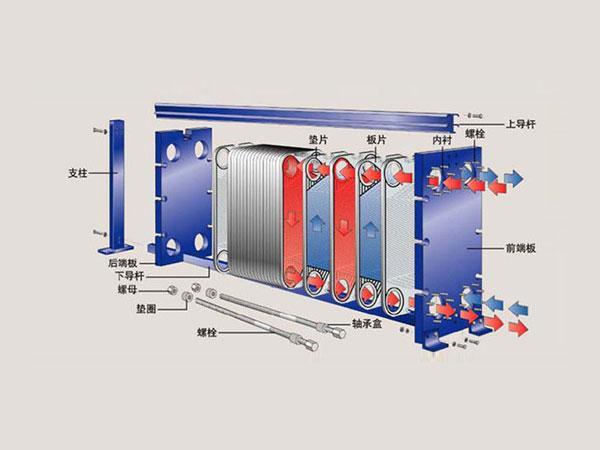
Plate heat exchangers are mainly composed of heat transfer plates, sealing gaskets, pressure plates, upper and lower guide rods, pillars, clamping bolts, etc. The four corners of the heat transfer plates have corner spaces and are inlaid with sealing gaskets. When the equipment is clamped, the sealing gaskets seal and connect various heat transfer plates according to the process combination form. The corner spaces are interconnected to form a labyrinth-like medium channel, allowing the heat exchange medium to flow in reverse in the corresponding channel, and to carry out sufficient heat exchange through enhanced thermal radiation, thermal convection, and thermal conduction.
Due to the special structure of the heat transfer plates, strong turbulence can be generated at a relatively low flow rate (Re=200) after assembly, thus accelerating the destruction of the fluid boundary layer and enhancing the heat transfer process.
The operating pressure of the plate exchanger is generally 0.3MPa-1.6MPa, and the operating temperature is generally below 160℃. When used for steam heating or condensation, a desuperheating shell and tube heat exchanger is generally added to the plate exchanger to cool and protect the gaskets of the plate exchanger and increase the steam processing capacity.

Welcome to Leave a Message
Contact Us
Shandong Youkun Energy Equipment Co., Ltd. will look forward to creating brilliance hand in hand with friends from all walks of life with high-quality products and thoughtful services!
Service Hotline:
Mobile:+86-18678686161 (Manager Zhao)
Phone:+86-546-2076999 +86-531-58780999
Company Address: South of Weiwu Road, West of Planned Jingqi Road, Kenli District, Dongying City