


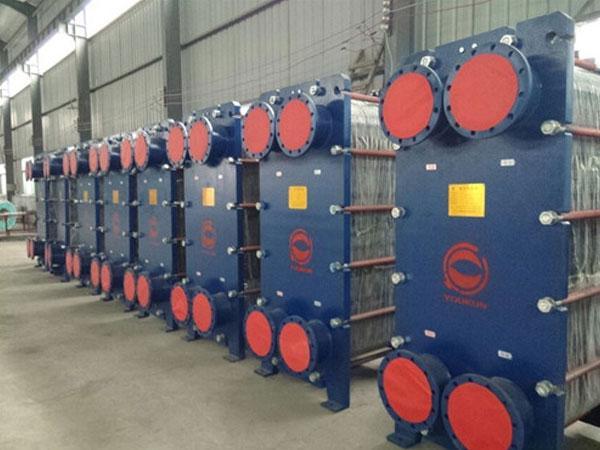
Plate heat exchanger
Keywords:
Product Category:
I. Overview
Plate heat exchangers have advantages such as high heat transfer coefficient, compact structure, small footprint, flexible operation, wide application range, low thermal resistance loss, convenient installation and use, and low investment cost. Therefore, they are widely used in petroleum, chemical, thermal power, metallurgy, light textile, food, medicine, HVAC heating, nuclear industry, shipbuilding, marine development and other fields.
With the development of modern industry, the rational use of energy and environmental protection are the primary issues to be solved by countries all over the world. As a highly efficient heat exchange product in the field of heat exchange, plate heat exchangers have long been valued by manufacturers at home and abroad. Our company has drawn on and absorbed the advanced technologies of the same industry at home and abroad, and cooperated with universities to research and develop high-efficiency, durable plate heat exchangers with internationally advanced level. The plates adopt a unique non-stick gasket structure, and the plate processing uses a unique process, which increases the operating pressure, operating temperature, and service life of the plate heat exchanger. We have independently developed plate types suitable for different media and flow rates, expanding the application range, significantly reducing investment costs, and improving the heat transfer coefficient. Using industrial automatic assembly lines improves product quality, enhances reliability and reputation, and has been well received by users.
II. Structure, Principle and Characteristics
Plate heat exchangers are mainly composed of heat transfer plates, sealing gaskets, pressure plates, upper and lower guide rods, columns, clamping studs and bolts. The four corners of the heat transfer plates have corner holes and inlaid sealing gaskets. When the equipment is clamped, the sealing gaskets are sealed and connected according to the process combination form, and the corner holes are interconnected to form a labyrinth-like medium channel, so that the heat exchange medium flows in reverse in adjacent channels, and fully exchanges heat through enhanced heat convection and heat conduction.
Due to the special structure of the heat transfer plates, strong turbulence can be excited at a lower flow rate (Re=200) after assembly, thus increasing the degree of destruction of the fluid boundary layer and enhancing the heat transfer process.
The working pressure of the plate heat exchanger is generally 1.0MPa~1.6 Mpa, and the working temperature is generally below 160℃. When used for steam heating or condensation, a desuperheating tube heat exchanger is generally added to the plate heat exchanger to cool down and protect the gaskets of the plate heat exchanger and increase the steam processing capacity. The material of the heat transfer plate is generally stainless steel; the sealing gasket generally uses nitrile rubber, ethylene propylene rubber, nitrile food rubber, fluororubber and other materials. The heat transfer plates and sealing gaskets can also be selected from other materials according to the different needs of users.
As a leading domestic manufacturer of heat exchange equipment, our company's main technical characteristics of its research and development products are as follows:
1. High Heat Transfer Efficiency
The corrugated structure design of the heat transfer plate is reasonable, which is conducive to enhancing heat transfer and allows the medium to form a violent turbulent state at a lower flow rate. The flow path adopts a rounded transition to avoid dead zones, and the possibility of scaling is greatly reduced, resulting in high heat transfer efficiency.
2. Long Service Life
The heat transfer plate adopts a non-stick gasket structure, avoiding the corrosion of the adhesive to the heat transfer plate; when the heat transfer plate is stretched and formed, a new non-simultaneous mold closing process is used to ensure uniform stretching of the plate, accurate corrugation size, and uniform corrosion resistance and mechanical strength of the heat transfer plate. This extends the service life of the plate heat exchanger. The design service life of our company's plate heat exchangers is 15 years.
3. Good Strength Performance
The flow path around the heat transfer plate adopts a reinforced structure; the corrugation size is reasonable; the contact points are evenly distributed. The pressure resistance is improved, and the maximum can reach 2.5Mpa.
4. Small Pressure Drop
The corrugation direction at the corner holes of the heat transfer plate scientifically adopts a streamlined shape to avoid dead flow zones, and the equivalent diameter of the flow path is increased.
5. Safe and Reliable Operation
The plate heat exchangers produced by our company use a double-seal structure for the sealing gaskets. Under the clamped state of the plates, the deformation is small, the resilience is good, and the seal of the gasket is reliable after assembly and maintenance reassembly. There is no internal leakage phenomenon in the heat exchanger. If there is external leakage, it can be found and dealt with in time. The sealing gasket ages slowly.
III. Installation
1. After unpacking the equipment, you should check each item according to the items listed in the delivery list. If there are any non-compliant items, you should immediately inform our company so that they can be resolved in time.
2. The equipment is equipped with lifting rings for hoisting. Before hoisting, select the hoisting equipment according to the weight indicated on the nameplate.
3. The equipment should be installed horizontally in a place that is not blocked by pipes or other equipment, ensuring that there is about 1 meter of space around the equipment for maintenance and repair.
4. The pump that transports liquid into the equipment should be equipped with a throttle valve; if the maximum outlet pressure of the pump is greater than the maximum pressure of the equipment, a safety pressure relief valve should be installed.
5. If a stop valve, throttle valve, pressure reducing valve, or pressure control valve is installed, it should be installed at the inlet of the equipment and not at the outlet.
6. Before installation, the inlet and outlet pipelines of the equipment should be cleaned to prevent debris such as sand, oil, and welding slag from entering the equipment, which may cause internal blockage or damage to the plates. It is best to install a filter before the equipment inlet to prevent various impurities from entering the equipment and causing blockage. For customers in areas with poor water quality, a descaling device should be installed before the equipment to ensure the heat transfer effect of the equipment and keep the equipment in optimal condition.
7. Sealing gaskets should be added at the pipe flanges, and the sealing gaskets should be accurately placed in the center of the flanges.
8. The water entering the equipment should be softened, which can improve the heat transfer efficiency of the equipment and extend its service life.
9. A bypass should be added to the inlet and outlet of the equipment. When the equipment is running for the first time, the water in the system can be circulated and drained, and the bypass valve can be closed after the water quality in the system meets the requirements, and the system can be officially operated.
10. Pressure gauges should be installed on the inlet and outlet pipes of the heat exchanger to monitor the working status of the heat exchanger and determine the cleaning time.
11. When the interface of the heat exchanger is connected to the pipeline, it should be in accordance with the pipe mouth table in the heat exchanger drawings to avoid the heat exchanger pipe being subjected to the expansion and contraction stress of the pipeline. After the installation is completed, make a good mark.
IV. Operation
1. Before operating the equipment, check if all bolts are loose. If loose, tighten them to the specified tightening size first.
2. Before starting, open all outlet valves of the heat exchanger and close the inlet valve. After starting the pump, slowly open the inlet valve of the heat exchanger, gradually increasing the pressure to avoid instantaneous impact and causing local high pressure to damage the equipment.
3. During the operation of the heat exchanger, to prevent overpressure on one side, the inlet valves of the cold and hot media entering the heat exchanger should be opened simultaneously, or the low-pressure side fluid should be slowly injected first, and then the high-pressure fluid should be slowly injected.
4. According to the indicators of the inlet and outlet thermometers of the heat exchanger, use the throttle valve to control the flow rate of the cold and hot fluids to achieve the required process parameters and stable operation.
5. If the heat exchanger stops for any reason, the operation steps should be carried out in the reverse order of starting.
6. When performing steam-liquid heat exchange, the gas passage side should be single-flow, and the inlet should be at the top.
7. For equipment used in the food industry, the heat exchanger should be thoroughly cleaned and disinfected before use. Hot water can be used during cleaning to remove air, oil stains, and debris from the equipment.
8. There should be air vents in the piping system. After starting, the air in the equipment should be removed to prevent air from staying in the equipment and reducing the heat transfer effect.
9. When the temperature difference between the two media is large, the low-temperature medium can be introduced first, followed by the high-temperature medium. In case of shutdown or power failure, the inlet valve of the high-temperature medium should be immediately turned off (the matching valve must be well-sealed and not allowed to leak, to avoid the gasket aging prematurely without heat exchange under high temperature), and then the low-temperature medium should be turned off.
10. If the cold and hot media contain large granular mud, sand, or other impurities, they should be filtered first. It is forbidden to use sewage for water pressure testing and operation to prevent affecting the service life of the equipment. (Our company specializes in producing various types of filters that match it. Please specify when ordering).
V. Maintenance
At the location where the heat exchanger is operating, appropriate range pressure gauges, sensors, thermometers, flow meters, etc., that have been calibrated should be installed on the inlet and outlet pipelines of the heat exchanger. The operating status of the heat exchanger is determined based on the instrument readings. When the heat exchanger operates for a long time, scale or sediment will be generated on the surface of the plates to varying degrees, thereby increasing the flow resistance and reducing the heat transfer performance. Therefore, it is necessary to formulate an operation cycle based on the actual state of the water quality or medium and conduct regular inspections and cleaning. During cleaning, mechanical cleaning or chemical cleaning can be used.
1. Mechanical Cleaning
(1) Loosen the heat exchanger, remove the clamping bolts, move the movable pressure plate towards the support, so that there is a certain distance between the plates, and then cleaning can be carried out. If it is necessary to replace the sealing gasket and the damaged plate, the upper end of the plate should be tilted towards the movable pressure plate, then removed from the hanging beam hanging hole, and the lower end of the plate should also be separated from the lower beam, and then the plate can be removed.
(2) For some operating media in the chemical industry, due to the influence of temperature or chemical reactions, solid substances are generated, and their composition must be analyzed to configure appropriate cleaning agents for washing or steaming.
(3) When cleaning the plates, use a palm fiber brush or fiber brush to brush, do not use a steel wire brush to avoid scratching the plates and reducing corrosion resistance.
(4) When sealing the gasket, clean it carefully to prevent scratching the gasket.
(5) After brushing the plates, rinse with clean water, and wipe the plates and sealing gaskets with clean cloth or cotton yarn to ensure that no solid particles remain on them.
(6) When assembling the heat exchanger, assemble it according to the process and check whether the arrangement of the plates is correct.
(7) Damaged plates and aged gaskets should be renewed.
(8) When clamping the plates, the diagonal order should ensure that the distance deviation between the upper and lower and left and right of the two pressure plates is not more than 8.0 mm. When clamped to the given clamping size, the deviation must be less than 2.0 mm. After clamping, the corner bolts can be tightened.
(9) Water pressure test: After equipment maintenance, a water pressure test should be carried out. No external leakage or internal leakage is considered qualified. The steps are as follows:
a) Check whether the clamping size meets the sample requirements.
b) Install the blind plate and pressure test pump, and install a pressure gauge at the pressure test pump port.
c) Use an appropriate medium (generally softened water with a chloride ion content of less than 5%) for pressure testing.
d) Completely discharge the air from the equipment and carry out unilateral pressure testing at 1.25 times the design pressure and hold the pressure.
(10) Leakage reasons
a) Medium internal leakage: The reason is that the plate is corroded and perforated or the seal is aged.
b) Medium external leakage: The reason is that the sealing gasket is aged or improperly assembled.
2. Chemical Cleaning
Chemical cleaning can be done without disassembling the plates. First, close the system inlet and outlet valves, connect a cleaning system to the heat exchanger connection pipe, and let the corresponding cleaning medium circulate in each side flow path. After the fouling is fully softened and detached, open the drain port to drain, and then rinse with clean water.
Note: The selected cleaning solution should not damage the plate material and sealing gasket.
VI. Maintenance
1. Heat exchangers that stop operating seasonally should promptly drain the medium inside the equipment or take other antifreeze measures to avoid freezing the equipment.
2. If the equipment is not used for a long time, the clamping bolts should be loosened to a size not less than 1.15L, and then clamped as required when used.
3. When the equipment is operating normally, if the medium is found flowing out at the signal hole, it should be analyzed. If the bolts are loose or elongated due to long-term heat exchange, they should be re-clamped according to the requirements, but not too tight to avoid damaging the plates. If the sealing gasket is aged, it should be replaced.

Welcome to Leave a Message