


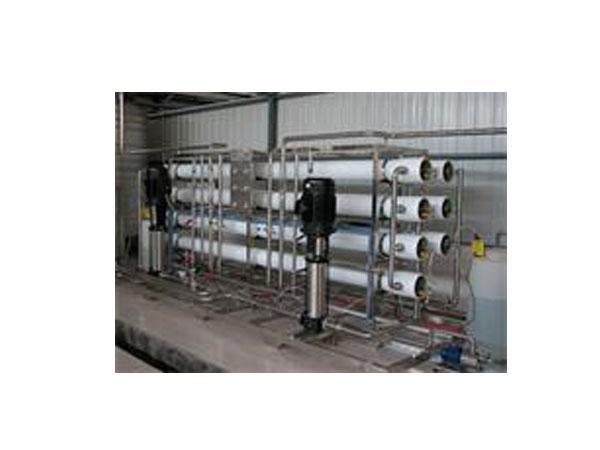
Reverse osmosis device
Keywords:
Product Category:
Reverse osmosis (RO) equipment is a membrane separation technology developed in the 1980s. It primarily utilizes the principle of osmosis in semi-permeable membranes. By applying pressure in a manner counter to the natural direction of osmosis, water from a concentrated solution is forced to permeate into a dilute solution. This process is known as reverse osmosis. A device composed of reverse osmosis components is called a reverse osmosis unit.
Main Process Flow Description
1. Raw Water Tank: Stores raw water. An antiscalant is used to precipitate large sand particles and other precipitable substances in the water. It also buffers the impact of unstable water pressure in the raw water pipe on the water treatment system (e.g., the response of pressure sensors to excessively low or high water pressure).
2. Raw Water Pump: Maintains constant system water pressure and stable water flow.
3. Multi-Media Filter: This filter uses multiple filter layers to remove particles larger than 20µm, including sand, rust, colloids, and suspended solids from the raw water. Manual valves or an automatic controller can be used for backwashing, forward washing, and other operations. This ensures the quality of the treated water and extends the life of the equipment.
4. Activated Carbon Filter: The system uses a shell-activated carbon filter. Activated carbon not only adsorbs electrolyte ions but also performs ion exchange adsorption. Activated carbon adsorption can also reduce the potassium permanganate oxygen demand (COD) from 15mg/L(O2) to 2~7mg/L(O2). Furthermore, due to the adsorption effect, the concentration of adsorbed substances on the surface increases, thus playing a catalytic role, removing water color, odor, large amounts of biochemical organic matter, reducing residual chlorine and pesticide pollutants, removing trihalomethanes (THMs), and other pollutants. Manual valves or an automatic controller can be used for backwashing, forward washing, and other operations. This ensures the quality of the treated water and extends the life of the equipment. The equipment also has a self-maintenance system, resulting in low operating costs.
5. Ion Softening System/Chemical Dosing System: To prevent scaling and improve the utilization of treated water in the RO system, especially to prevent the precipitation of CaCO3, MgCO3, MgSO4, CaSO4, BaSO4, SrSO4, and SiSO4 in the concentrate side of the last membrane module due to the concentration product exceeding the equilibrium solubility constant, thereby damaging the membrane components, an ion softening system or a proper amount of antiscalant should be used to prevent the crystallization of carbonates, SiO2, and sulfates before entering the reverse osmosis membrane modules.
6. Precision Filter: A precision filter removes remaining suspended matter, non-dissolved particles, and colloids from the incoming water, ensuring safer and more reliable operation of subsequent equipment such as the RO system. The filter element is a 5µm melt-blown filter. The purpose of using dimethyl silicone oil is to remove impurities larger than 5µm that may have passed through the previous filtration stage. This prevents them from entering the reverse osmosis unit and damaging the membrane surface, which would affect the membrane's desalination performance.
7. Reverse Osmosis System: A reverse osmosis unit uses sufficient pressure to separate the solvent (generally water) from a solution through a reverse osmosis membrane (or semi-permeable membrane). Since this process is opposite to the direction of natural osmosis, it is called reverse osmosis. Reverse osmosis can handle raw water with various salt contents, and it is particularly effective in high-salt water treatment projects, offering excellent technical and economic benefits. Reverse osmosis offers high desalination rates, high recovery rates, stable operation, small footprint, and ease of operation. In addition to desalination, the reverse osmosis equipment also removes most bacteria, colloids, and high-molecular-weight organic matter.
8. Ozone Sterilizer (Optional): Kills bacteria generated by secondary pollution, ensuring the hygienic quality of the finished water.

Welcome to Leave a Message